Despite the fact that the great Armenian director Sergei Parajanov, alas, never managed to live on Armenian soil, although he had such plans, it was in Yerevan that his house-museum was opened. This country always treats all its children with tenderness and sincere love, even those who by the will of fate turned out to be prodigal. Parajanov was born in Georgia, spent a lot of time there, and lived in Moscow and Kyiv for a while. Even those people who are not familiar with the director’s work, according to Armenian tour operators, will be curious to visit the museum dedicated to him. Firstly, perhaps this will inspire them to watch several famous films. And secondly, Parajanov was not only a great master of cinematography, but also a great mystifier, a mocker, who first of all molded the space of his own life and created amazing absurd pictures. All this, of course, was reflected in his legacy, and therefore a visit to the museum turns from a decorous cultural event into a bright attraction.
Sergey Parajanov is a recognized master of avant-garde cinema, who introduced a new stage language into circulation. At the same time, all his techniques and images are nurtured by ancient Christian traditions and the centuries-old cultural heritage of Armenia. So with his pictures he paid tribute to his roots.
Parajanov’s works were also appreciated by foreign masters. Federico Fellini, Louis Aragon, Michelangelo Antonioni, Francois Truffaut and many others expressed their admiration for such films as The Color of Pomegranates and Shadows of Forgotten Ancestors. Among Russian masters, Tarkovsky and Vartanov highly valued his work. Some of the techniques used by Parajanov in his works were creatively rethought by other masters. So, despite some modern oblivion, one cannot help but note the influence of the master on the development of modern culture.
Although Parajanov was not lucky enough to live in the homeland of his ancestors – he was born in Tbilisi to an Armenian family – the director left his entire rich legacy in Armenia. Parajanov was an amazingly multifaceted personality – therefore his legacy did not consist only of works related to cinematography. Initially, he studied at the construction department of the Institute of Railway Transport, then took violin and vocal lessons at the Tbilisi and Moscow Conservatories, studied dance at the Tbilisi Opera House, but eventually chose cinema and graduated from VGIK. Parajanov drew brilliantly, made beautiful collages. In general, he turned all the living space around him into high art. Which allowed descendants to admire the rich legacy left by the master, but cost his loved ones dearly. Because of the craving for shocking, the inability, and even the unwillingness to adapt to the blurry, gray and amorphous body of the surrounding philistine masses, not only Parajanov suffered, but also his family.
His first marriage fell apart, although the spouses maintained a warm relationship, the son was raised by his ex-wife, although the boy often saw his father. As a result, Parajanov even spent several years in prison and a colony, accused of sodomy. Although most of his friends and acquaintances assume that the director was heterosexual, he could say anything in his unexpected mysteries and desire to shock others. And the reason for the arrest was a not entirely innocent joke that sounded in an interview with the director, published by one of the Danish newspapers – as if as many as 20 members of the Central Committee of the CPSU were thirsty for lovemaking with Parajanov. This, and a letter in defense of the Ukrainian intelligentsia, persecuted in the late 60s, cost Parajanov 4 years in prison. This extraordinary person, who always wanted to stand out, took the imprisonment hard. He could not adapt to prison customs, and the prisoners suspected that he asked for it himself in order to subsequently make a film about life in captivity. But it was this tragedy that gave the world the symbol of one of the cinematographic awards. A portrait of Pushkin, scratched with a nail on an aluminum kefir lid, had an amazing and adventurous journey before ending up in the hands of Federico Fellini. He liked the thing so much that he cast a silver medal in its likeness. Now such medals are awarded to winners of the Rimini festival.
Another prison work – a shroud painted with amazing biblical images, which Parajanov created especially for his cellmate, who died on the neighboring bunks, is now kept in a museum in Yerevan. In addition to this sad work, the museum’s exposition paints the image of an unusual person, demonstrating dolls, ceramics, collages, drawings and much more created by Parajanov during his life. In total, about six hundred of the master’s creations, made in various forms and styles, are collected here. In addition, the museum features two rooms where the creators of the museum were able to reconstruct the atmosphere and interior decoration of his home from the director’s personal belongings that were kept in his apartment in Georgia. This tour of Armenia will allow fans of Parajanov’s work to learn
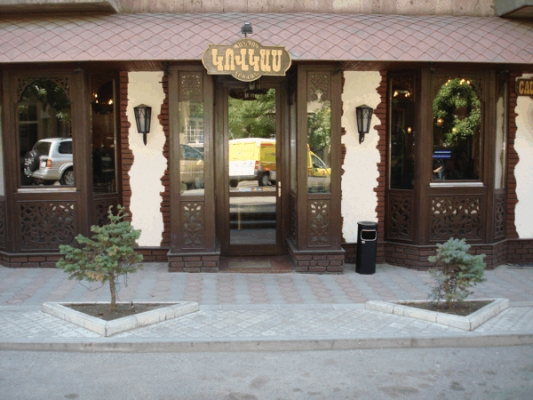
It is not difficult to find a restaurant or even a snack bar in Yerevan that serves local dishes. But it is better to get acquainted with the delicacies of the cuisine of this region in a restaurant with a sonorous and all-explaining name “Kavkaz”. When the owner of the establishment opened his brainchild, he first of all dreamed of reviving a traditional dining room on the streets of the capital of Armenia, where guests could not only savor dishes prepared according to ancient recipes, but also feel all the charm of this region, famous for its love of life and hospitality. Tour operators of Armenia recommend this place to everyone who would like to get to know this country through the stomach.
This idea did not end with just a conversation with elderly relatives. In order to find the real recipes for long-forgotten dishes, many written sources were studied, from scientific treatises and archival records to fiction. Assuming that the interior of the establishment should fully correspond to the quality and nature of the dishes prepared here, the owners tried to recreate the inner chambers of the taverns that adorned Yerevan and Tiflis in the century before last. They succeeded, and “Kavkaz” is a very atmospheric place, which in a blink of an eye transfers you to the amazing and romantic world of the Caucasus of the nineteenth century. And it is so nice that it is located near the largest hotels in Armenia.
From the first second, guests are captivated by the charm of the interior. The walls themselves are built of stone with brick inserts, the surfaces are framed with reeds, straw and canvas, and massive wooden tables beckon with their velvety relief surface. All metal elements, right down to the hinges and door handles, are hand-forged – the owner pays close attention to even the smallest details.
The same principle rules in the kitchen. The masters of pots and pans carefully select only fresh and natural ingredients, following ancient recipes. They carefully sprinkle the dishes with herbs, like alchemists, choosing the right ones from a long battery of various bottles. They really are all a bit of magicians here, who know how to turn the most ordinary products into an amazing love potion. After the first bite, you will feel an irresistible passion for Caucasian cuisine. That is why it is often chosen as a vacation spot by tourists from Russia, Ukraine or Uzbekistan, and the prices here are not exorbitant.
The cozy beautiful halls often host boisterous feasts – people like to celebrate weddings and birthdays here, as well as raise glasses in honor of another achievement in business. “Kavkaz” is a tavern bustling with life and joy, not a pompous restaurant.
Here they offer not only Armenian dishes, but also unique Georgian dishes. The menu is full of appetizing-sounding names: kupaty, chakapuli, ostri, harisa, khash, tolma, etc. You want to try everything and only a healthy sense of self-preservation stops you – you can burst!
The restaurant is also kind to fish lovers – not all meat eaters are fed. Here you can try sterlet in a variety of variations and even Garni trout. Visitors choose a suitable specimen right in the aquarium. So if you were unable to visit Garni during your tour of Armenia, at least try the local fish.
It is customary to wash down all this culinary luxury with wine, which is available here in abundance. You can try Georgian or Armenian. The latter will be poured for you straight from a huge barrel. Those who prefer calming drinks to cheerful ones should try the local pride – real Armenian tea made from thyme or mint. Or the extremely healthy linden tea, which is brewed according to a special recipe that has been preserved since the Middle Ages.
The tavern itself is divided into four parts. There is an Armenian hall, a Georgian one, a mysterious oriental one, and a cool wine cellar Maran. They differ not only in the entourage and choice of dishes, but also in the musical accompaniment. Every evening, the soul-stirring sounds of live music are heard in two of them. The lyrical and mysterious words of the ashughs accompany the melodies played by the duduk, drum and oud.
Contacts
Tel.: (+374-10) 56 11 77, (+374-10) 56 26 14
Address: RA, Yerevan, st. Hanrapetutyan 82
Русский
Deutsch
Italiano
Français
Español
中文