This name is translated from the Kyrgyz language as Black Hand, however, in the period from 1889-1922 and 1939-1992 the city was called Przhevalsk. Its population is 63.4 thousand people.
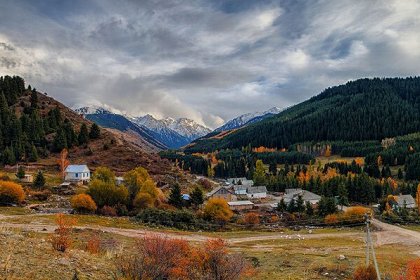
The city is located in the east of the region, at the foot of the Terskey-Alatoo ridge, in the lower reaches of the Karakol River. Issyk-Kul is 12 km from the settlement. The distance to Bishkek is 400 km, to the Balykchy station – 220 km.
Due to its picturesque places and mountain landscapes, tourists, climbers and trekkers flock here.
In the area of the Terskey-Alatoo ridge in the Karakol gorge, 7 km from the city, in the grandeur of mountain forests, the Karakol ski resort is located. The difference in altitude in this area is from 2300 to 3450 meters. In Soviet times, Olympians trained here.
To the west of Karakul, along the southern shore of Issyk-Kul, 30 km away, are the resort areas of Jeti-Oguz (Seven Bulls) and Jili-Su (Warm Water). 10 km to the east, there is a health resort with healing muds, Dzhergalan. 50 km away, at the foot of the Tien Shan, is Lake Merzbacher.
The city was founded in 1869, and became a military and administrative center on the caravan route from the Chui Valley to Kashgaria. The founder is considered to be Staff Captain Baron Kaulbars. The city got its name in honor of the river flowing in this area. This is perhaps the most well-maintained and clean town in pre-revolutionary Kyrgyzstan. It is literally buried in greenery.
The architecture of the buildings was also distinctive. If before 1887 there were mainly adobe buildings here, then after the earthquake they began to build wooden houses decorated with carved porches. Such houses resembled Russian villages.
Over the course of several years, the city managed to change its names several times. Until 1889, it was called Karakol, then by decree of the tsar it was renamed Przhevalsk, in honor of the famous traveler N.M. Przhevalsky. Making his 5th journey, he reached Karakol and died in this city of typhoid fever. He was buried on the shore of Issyk-Kul.
In 1922, the city was given its former name again. And in 1939, the 100th anniversary of N.M. Przhevalsky was celebrated and it was decided to call this regional center Przhevalsk again. The last renaming of the city took place in 1992, when Kyrgyzstan gained independence and it was decided to call Przhevalsk Karakol.
Famous scientists and travelers visited here in their time:
- In 1887, Ya. I. Korolkov opened the first meteorological station in Kyrgyzstan;
- Barsov N. M. opened the first public library;
- On the initiative of Staff Captain V. A. Pyanovsky, the first stud farm appeared here.
By 1914, up to 60 small industrial enterprises operated in Karakol. You can learn more about them by taking a tourist tour to Kyrgyzstan.
Due to the city’s remoteness from the center, during the Soviet period it was decided to build a military base for testing torpedo boats in the village of Pokrovka (near Korakol).
As for the city’s attractions, they also exist, although there are not many of them:
- The Dungan Mosque, built in the style of a Buddhist temple from wood without the use of nails. It was built in 1910.
- The Russian Orthodox Church – “Holy Trinity Cathedral”, it was built in 1872, a wooden building on a brick base.
- The N.M. Przhevalsky Park-Reserve, where his grave with memorial buildings is located. The place is located at the pier on the shore of Issyk-Kul.
- Near Issyk-Kul there are remains of a settlement dating back to the 14th – 15th centuries. Its main part rests on the bottom of the lake.
Today Karakol is the industrial center of the Issyk-Kul region. The following areas are developed here:
– Mechanical engineering – JSC “Issyk-Kulelectro”.
– Food and processing focus – JSC “Karakol-Buudai” for grain processing, JSC “Ak-Bulak” for milk processing, JSC “Seyil” for the production of soft drinks, JSC “Toshtuk” for the production and processing of meat.
– Production of building materials – JSC “Temir-Beton”.
– Light industry – LLC “Ata-Kench”.
Karakol is a free economic zone of Kyrgyzstan.
The city is also the administrative center of the Issyk-Kul region, with a population of 65 thousand people. There are 11 schools, several universities and institutes in the city. Tourists can visit the local history museum, which displays exhibits related to the history of the city, the culture and life of the Kyrgyz people. Many exhibits are related to the natural and climatic features of the region.

Русский
Deutsch
Italiano
Français
Español
中文