It seems that in Armenia you can find any historical and cultural attractions to suit your discerning taste. Therefore, you just need to book a flight with Uzbekistan Airways to Yerevan, choose one or several hotels in Armenia for your stay and set off on a journey to get to know this amazing country. Charming small churches, ancient fortresses, monasteries cut into the thickness of the rocks, monuments of the Bronze Age – this is by no means a complete list of attractions. There is also an ancient temple here, which is located near the village of Garni, famous for its amazing attractions. However, this temple is usually called pagan in Armenia. The structure is absolutely unique, despite the fact that before the arrival of Christianity in these lands, Armenians professed various cults, including worshiping Greek gods, the sanctuary in Garni is the only one that has survived to this day. Perhaps, such a structure will not be found during a vacation in Uzbekistan.
Now there is a beautiful temple and ruins of other buildings, and once on the hill there was a proud fortress, the residence of the Armenian kings of ancient times. The temple itself was dedicated to the god of the sun Helios or Mithra, and it was founded along with the rest of the ensemble by King Trdat I. Having created this architectural composition, King Trdat, according to the good tradition of these lands, also left a corresponding inscription carved on a stone slab, which made life much easier for archaeologists. Translated from Greek, the message to descendants sounded something like this: “Helios! The Great Trdat, the ruler of no less great Armenia, built this fortress, impregnable to enemies, in the 11th year of his reign. Unfortunately, many buildings have fallen into disrepair over the centuries, and the remains, forlornly whitening under the hot Armenian sun, tell only of their former greatness. But the temple has survived to this day, despite the adoption of Christianity almost two centuries after its construction.
King Trdat I was a bit disingenuous – the first fortress appeared on these lands 3 centuries before his reign (in the second century BC). The ruler only made the fortifications even more impregnable. Subsequently, other kings followed his example – this defensive structure occupied a very advantageous place. Ultimately, thanks to numerous reinforcements over several generations, Garni became a magnificently fortified citadel. Powerful walls and towers protected the inhabitants of Garni from destructive raids of warlike enemy tribes for a whole millennium.
Armenian secular rulers had a special affection for the Garni fortress, and even chose it as a place to stay during the summer months. The reason for this was not only the impregnable walls, but also the magnificent nature, and at the same time the exceptionally mild climate. In the summer, it is so pleasant to hide from the stupefying Yerevan heat here. Although the distance between these two cities is very small – a little less than 30 kilometers, Garni is located in the foothills, which affects the climate.
People lived here even during the heyday of the Urartian kingdom in the eighth century BC. When King Argishti decided to build the Erebuni fortress on the site of the future Yerevan, he first conquered the settlement of Garni. Having captured the locals as free labor, he set out to build his citadel. This fact is evidenced by a small tablet decorated with cuneiform that was found in Garni. So this place always seemed attractive to the people living on these lands. The fortifications were not always perfect.
The location for the fortress and the temple was ideal. A triangular cape, which is braided by a ribbon of a mountain river, shining far below, a gorge, grinning with sharp rocks and frightening steep cliffs, and so well protected the hill from evil intentions. The slopes running down to the river are so smooth that it seems that they were paved with slabs by people. In fact, these creations were created by nature, and people only gave them the name “Symphony of Stones”. The part of the hill that did not receive natural protection was fenced with almost impregnable walls, where a large number of defensive towers were installed. Although the towers and walls were also erected on the side of the gorge. No mortar was used in the construction, the blocks were fastened together with iron clamps, and lead was poured into the corners.
Inside, everything was done with an exceptional sense of comfort and elegance. Of course, because the king of Armenia himself was housed here. There were many buildings inside the fortress. The palace was located on the southern side, and the north was given to the army and the outbuildings, the ceremonial hall was erected near the cliff, and residential buildings were located near it. There were also baths here. Judging by the surviving decorative elements: the floors in the ceremonial buildings were laid out with intricate mosaics, drawing Hellenic patterns. Traces of rich and colorful paintings remained on the walls. And it is best to preserve
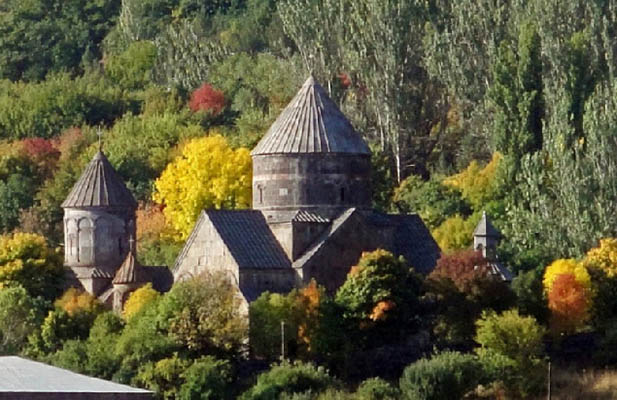
Along with the sports kingdom, the city of Tsaghkadzor also attracts tourists with its unique Kecharis Monastery. So you should definitely include a visit to it in your tour program in Armenia. The first buildings here appeared in the eleventh century, and the construction of the first temple at the monastery was dedicated to the famous educator and spiritual leader in the Armenian lands, St. Gregory. Another famous church here was built in honor of the Holy Sign. In total, there are four churches, two small chapels and a cemetery on the territory of the monastery, which is guarded by ancient khachkars, amazing with their skillful stone carving. Perhaps the most beautiful church in the complex is Katoghike, which was built here at the beginning of the 13th century by order of Prince Khakhbakyan. The monastery flourished in the twelfth and thirteenth centuries, when a school was opened within the local walls, and the brothers and abbots themselves made great efforts not only to improve the temple land, but also to bring education and the light of faith to the surrounding lands.
In the nineteenth century, the monastery was severely damaged by an earthquake, and spent almost a century in a sad, dilapidated state. However, at the end of the twentieth century, large-scale reconstruction work was carried out here, and most of the buildings regained their former beauty and grandeur.
Tsaghkadzor is not only a famous ski resort, but also a famous health resort. Not only mere mortals come here to improve their health, but also famous athletes, as well as national sports teams for training. And the whole point is that the local rarefied air (the city is located at a high altitude above sea level), as well as the composition of the atmosphere, have an amazingly beneficial effect on the composition of the blood, significantly increasing the hemoglobin content in it, thereby saturating the body with oxygen. So both intensive training here is much more effective, and just rest is good for health. It is not for nothing that the locals are so proud of their longevity and the amazing resistance of their strong body to all sorts of ailments. So we are planning a cheap tour for ourselves, or an expensive one, and for longevity we are going to Tsaghkadzor, a wonderful city of immunomodulators! Because health is priceless.
Русский
Deutsch
Italiano
Français
Español
中文