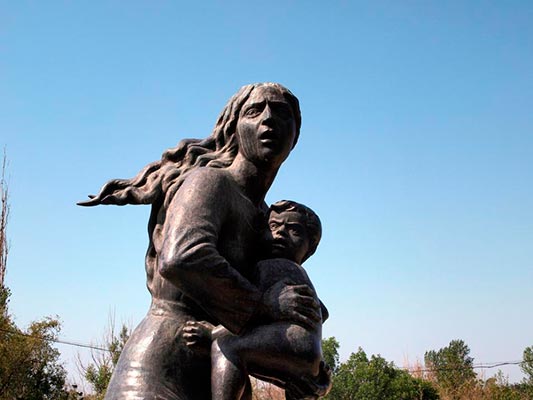
ARMENIAN GENOCIDE MUSEUM IN YEREVAN

Perhaps the most terrible and heartbreaking story in the history of Armenia is the genocide of the Armenian people, which is usually called the Great Crime. Historians disagree on when to count the beginning of this nightmare, but it is generally accepted that these events took place in the period from 15 to 17 of the last century. The tragic events took place on the territory of the Ottoman Empire. During this short period of time, the Turks destroyed more than a million Armenians. Although historians still find it difficult to name exact figures, and if the Turkish official position, which generally denies the fact of genocide, names figures of approximately 100-200 thousand (attributing losses to the events of the First World War), then the Armenian authorities assume that the true scale of the tragedy was much more terrible – from 1.5 to 2 million victims.


The position of Armenians in the Empire was already very precarious and difficult by the end of the 19th century. By the beginning of the new century, at least several events had occurred that were harbingers of the coming tragedy – for example, in 1895, at least several terrible events occurred – the massacres in Sasun, Istanbul and Van. However, the real dramas awaited the Armenian people ahead. With the beginning of the First World War, the situation deteriorated sharply. Jihad was declared in the Ottoman Empire, and the Armenians, as dissenters, automatically became if not enemies, then suspicious elements. Despite the fact that the Armenians in their majority were loyal to the authorities and did not at all strive for a revolutionary change in the order, they did not inspire confidence in the authorities. The Ottoman Empire, entering the war, professed one of its main ideas to unite the Turkish tribes and Muslims under its veils, and the Armenians did not fit into this idyllic picture at all.


The Armenians had suffered from various discriminations before. The authorities deprived them not only of privileges, but also reduced them to the level of practically disenfranchised and powerless citizens. Armenians could not act as witnesses in court, they were denied the right to bear arms, and taxes were simply disproportionately high. And after the terrible defeat of the Turkish army at Sarikamish, where the imperial troops clashed with the Russian army, they decided to simply get rid of the Armenians. And not just expel them and send them outside the Ottoman Empire, but physically destroy them. The most amazing thing is that the Turkish army consisted largely of Armenians, and they showed miracles of bravery and courage in that damned battle. Moreover, even the commander was saved by an Armenian officer. However, the fate of the people was already predetermined, especially since Armenian volunteers living outside the territory of the Ottoman Empire joined the Russian troops and participated, among other things, in the battles near Sarikamish. The Armenians were classified as traitors, all their personal weapons were confiscated, and a campaign of extermination of the population began.


The chronicle of this nightmare is full of terrible and incredible details. No one could help the Armenians – the Turkish population was forbidden to support their neighbors under pain of death, and diplomats could do nothing about these horrors. Moreover, outside the empire, many did not even suspect that events were taking place. Men were often simply shot, but women, old people, and children sometimes suffered a more terrible fate. Girls, especially beautiful ones, were often raped before being killed, children and old people were starved, often taken to the sea and drowned. When communities were relocated from one place to another, people were often forced to wander senselessly through hot, ethereal lands, without providing them with food or drink. Stragglers were mercilessly shot. Another nightmare was the medical tests that were conducted on young Armenian soldiers. They were injected with blood infected with typhus in order to develop a vaccine against this disease. And children and pregnant women were experimented on, using various poisons. As a result of such “scientific research”, hundreds, and possibly thousands of innocent people died.


The most terrible thing is that this fact was not even recognized by all countries, and although a tribunal was held after the end of the war, the main culprits managed to escape punishment, they fled abroad in time. Most countries still confirm both the genocide and the responsibility of the Turkish authorities for it. But the Turkish government itself still refuses to recognize the fact of the genocide of the Armenian people, moreover, Turks who express the opposite point of view are subject to persecution and political persecution.


However, it is not even about historical justice. Almost every Armenian can name one of his direct ancestors or relatives who became victims of genocide. Therefore, it is simply impossible to forget such a tragedy. But so that such horror never happens again, so that the events do not sink into oblivion and become known to future generations, the memory of the tragedy was immortalized in a memorial. This is an incredible place, not so much frightening as it is acute and boundless real grief for so many lives, interrupted with senseless cruelty and for the sake of abstract, little understood ideas today. Rage and anger are not felt here, only endless and bright sadness.


The Day of Remembrance of the Victims of the Great Crime is still celebrated annually on the same day throughout the world, where there are Armenian diasporas. And in Yerevan, the opening of a museum dedicated to this tragedy was timed to the 80th anniversary of the beginning of these tragic events. The halls of this complex contain a huge number of various documents that impartially and with crystal clear severity tell the entire history of the relationship between Armenians and the authorities of the Ottoman Empire, which ended so terribly. Tour operators of Armenia advise everyone who finds themselves in Yerevan to look at this amazing monument.


The building itself was designed by Lyudmila Mkrtchyan and Sashur Kalashyan, and is gracefully integrated into the mountain top. If you climb up to the roof of the building, you can see amazingly peaceful pictures of the impressive Ararat and the nearby valley. And in the center of the courtyard, a sharp stone arrow of a khachkar pierces the sky. The author of this project is the architect Arakelyan.


The museum is almost completely hidden underground, it personifies a tomb – for many unidentified and unfound victims, it became the last refuge and the only memory. The roof opens with steel petals, which in a quiet and inescapable craving strive for the indifferent heavens. Hellish circles are symbolized by a round interior.


The building itself consists of two floors. On the upper floor there are exhibition halls, where a huge collection of various photographs, documents and exhibits is collected, which make up a complete and horrific chronicle of the Armenian Genocide, which was committed on the territory of the Ottoman Empire. Documents provided by other countries, in which they condemn the Great Crime, are also exhibited here. In one of the halls, which is located in the open air, there are 12 stone steles on which messages from famous people are carved condemning those tragic events.


On the lower floor there are work rooms, since the memorial complex not only narrates and exhibits, but also continues to study historical events. In the museum, in addition to the library and offices, there is a conference room and a large storage of documents.


The museum is very crowded every day, and everyone from young to old comes here, and many rush to bring flowers to the memorial site. Even if the place is filled with boundless and pure sadness, and permeated with terrible and painful grief, even small children are brought here. They should also know about what happened a hundred years ago. A tour here is one of the most famous tours in Armenia.


According to an established tradition, all politicians and representatives of foreign countries must visit this memorial complex to lay flowers, as well as plant another tree, and there are already many of them decorating the Alley of Memory.


Before heading to the museum, and it is certainly worth visiting, first call the administration to find out if the complex is open. Or try to get up-to-date information at the hotel in Armenia where you are staying. Since the beginning of 2015, Tsitsernakaberd has been closed for major repairs.


To get here, you need to either book a tour or get to the museum yourself. You can travel by metro and get off at the Marshal Baghramyan station, or get there by bus or minibus, the stop is called Hamalir.


The memorial complex is open to visitors from 11 am to 4 pm, except for the day off – Monday.