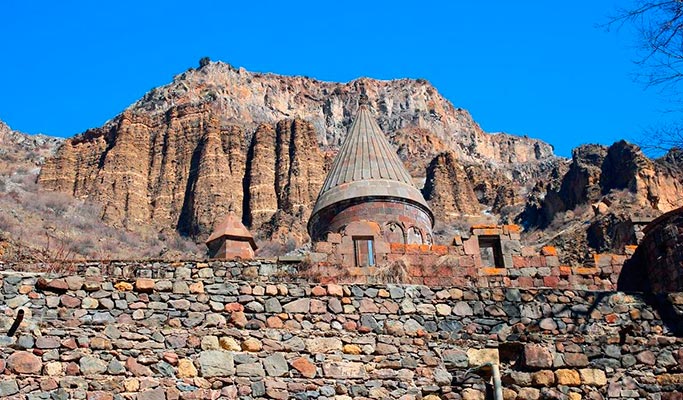
The rocky cliffs of the Goght River gorge, covered with delicate greenery, sheltered one of the most striking sights of Armenia – the Geghardavank Monastery – within their impregnable walls. This is an amazing complex, which consists of buildings erected on the mountain slopes and carved out of the rock at different times. The monastery received its current name thanks to one of the relics that was kept here for a long time – the spear that pierced Christ. According to one legend, the sacred relic was brought here along with other gifts by the Apostle Thaddeus. This treasure is still in Armenia, it was simply moved to another monastery. Geghardavank is not just a Christian shrine that attracts many pilgrims from all over the world, but also a structure of amazing beauty, glorifying the skill and diligence of its creators, who carefully and with infinite respect inscribed the appearance of the temples into the surrounding natural beauty.
The gorge has always been a sacred place, as early as the 4th century BC, the first structures appeared in local caves near a life-giving spring. According to legend, Christianity was brought here, as well as to all of Armenia, by St. Gregory the Illuminator, who founded the first monastery on this rocky land. At that time, it was called Ayrivank, which means a monastery located in a cave. It was a stronghold of faith, bringing enlightenment to all who thirsted, a real treasury (and there was also an abundance of material wealth here). The monastery fell victim to the elements and barbarity, and the earthquakes caused much less destruction than the Arabs, who practically razed all the buildings to the ground and burned all the manuscripts to the ground in the 10th century.
The monastery was given new life by the liberation of Armenian lands from the Seljuks by Georgian troops. The brave commanders of Queen Tamara rebuilt part of the monastery, after which its care and the construction of other buildings were carried out by the Khakhbakyan family, representatives of the Armenian noble family. So all the structures of the temple complex that exist today appeared in the 13th century, almost 3 centuries after the destruction of the first monastery.
You can go and see the monastery on your own, but if you do not have a vehicle, it is better to book an excursion – the complex is located forty kilometers from the capital. Moreover, this is one of the most interesting tours of Armenia. Don’t let the mysterious tongue twister Garni-Geghard confuse you at the tourist office, often a trip to the monastery is combined with a visit to another architectural monument – the Garni Temple, which was built to worship pagan gods. The shrines of different religions are located close to each other – Garni grew up with walls on the Azat River, which is fed by Goght.
The monastery complex itself is unique – part of it seems to grow out of the thickness of the rocks, drawing strict geometric pictures with external facades, while the rest of the temple is carved in the thickness of the stone, other buildings are inscribed in the space of natural caves or carved in rock formations. Only a small part of the premises is under the open sky, so that the cliffs of the gorge themselves are transformed by human hands into a huge monastery. Stone is the main material here, even the details of the decorations are carved from it. The main example is khachkars, stone obelisks carved directly into the walls and decorated with crosses. The skill with which this titanic work was done still amazes, which is why Geghard was added to the awe-inspiring series of World Cultural Heritage monuments by UNESCO.
The monastery complex consists of several churches, a sacristy and the main temple, which were built at different times. All the interior decoration is enchanting with its severity and at the same time amazing openwork decoration, especially the use of light – it falls from above, turning stone pillars into mysterious tree trunks, sharply outlining the carving on the walls, making it more alive and convex. The outer walls of the complex – the Katoghike temple, are made in a strict manner and gravitating towards clear geometric lines. From the inside, the halls of the Gavit sacristy and the Avazan church resemble underground chambers with their powerful vaults and richly decorated walls. The masters brilliantly used the available materials, where nature created its masterpieces, they left part of the rock untouched. So stalactites, slowly growing year after year, were inscribed in the ceiling space.
A trip to Gerard, planned as an ordinary excursion, in fact turns out to be a magical journey, full of unexpected discoveries and vivid memories, engraved in the memory, like local temples in the thickness of the rock. An amazing feeling of unity with oneself and the surrounding world, admiration for the monumental and at the same time fragile beauty carved out of eternity, embraces everyone who is lucky enough to find themselves here. Unfortunately, it is unlikely to be included in the last minute tour program, but you should definitely go here.
Monastic complex s is located in the Kotayk region, on the right bank of the Azat River, in the gorge of its tributary, Gokhta. From Yerevan, you need to move in a south-east direction for about 40 kilometers. In order not to get lost on the road, Armenian tour operators still recommend purchasing an excursion.
Русский
Deutsch
Italiano
Français
Español
中文