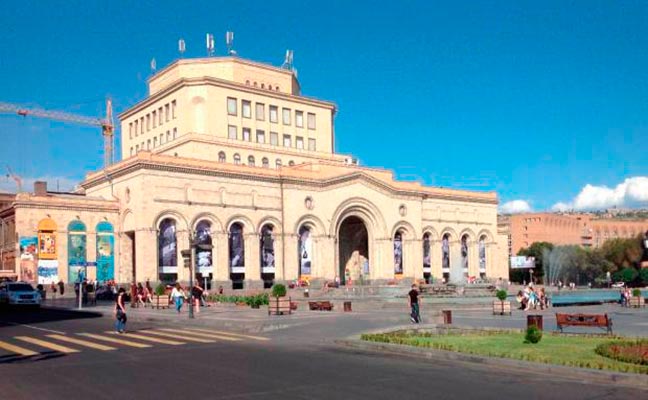
National Art Gallery of Armenia

Republic Square, the acknowledged heart of Yerevan, holds many unique cultural institutions in its vastness. One of the most beautiful and harmoniously sculpted buildings in the square ensemble belongs to two museums at the same time: the History of Armenia and the Art Gallery. Both collections appeared simultaneously in 1921, immediately wisely dividing the territory of the building they inherited. History is on the lower floors, art on the upper ones. Convenient for visitors and symbolic. And near the building there are many hotels in Armenia.


The National Art Gallery of Armenia is the main treasury of fine arts in the country. In terms of size, and most importantly, the value of the collection, the gallery can compete with the leading museums of the world and is among the largest in the former Soviet Union. It is rightfully proud of its unique collection of paintings by Armenian masters – you will not find such a variety of wealth in any other museum in the world. Here you can also see many works by the greatest marine artist Aivazovsky, their collection in the state gallery is considered the most complete, and best reflects the evolution of the master. Include this museum in the program of a tour of Armenia if you are a fan of the work of this painter.


In general, the museum, both in the exhibition halls and in the “storerooms”, stores more than twenty thousand different paintings and other masterpieces of visual art. At the same time, the art of Western Europe is represented here by about 350 different works of art. Although this collection includes works by famous and recognized masters. These, without any doubt, include such authors as Rubens, Kandinsky and Chagall, and this is by no means a complete list. Tour operators of Armenia believe that this is a unique place for lovers of painting.


The collection of masterpieces by such famous Russian artists as Surikov, Bryullov and Repin is pleasing to the eye and well-chosen with taste and love.


But the main pride is the unique in its size and composition collection of various works created by Armenian masters in different eras. Here you can see medieval works, unique frescoes and elements of church paintings. These are not originals, but talented and masterfully made copies, since it is not customary to take images from churches and temples here. But the canvases dating back to the 18th century are already undoubtedly originals. Moreover, the oldest and most famous paintings belonging to this period are the fruit of the labors of the famous Ovnatyans family. This is a great dynasty that existed for two centuries and gave the homeland and the whole world five generations of brilliant artists, some of whom even became the founders of certain genres in Armenian art. Other halls feature famous Armenian artists who worked at the turn of the nineteenth and twentieth centuries, in the genres of impressionism, expressionism, etc. These are famous masters Sureniants, Saryan, Tadevosyan and others.


The collection of Italian painting is noteworthy, where you can find works dating back to the fourteenth century. One of the most mysterious paintings is called “Christmas” and belongs to an unknown artist, whom the authors classify as part of the circle of the famous maestro Botticelli. In the Italian retrospective, you can mainly find paintings of the High Renaissance. The paintings depict ancient subjects and biblical themes. Although there are also several landscapes. The museum’s collection is constantly growing, for example, the Gallery recently received a work by Bassano as a gift. Several paintings by the famous master were exhibited here before. In the Italian halls you can see several portraits of the eighteenth century, painted by the brilliant artists Strozzi and Guercino. Modern works by European masters can be found only in the French and Spanish halls, and these are rather canvases dating back to the turn of the nineteenth and twentieth centuries.


In the Gallery you can also get acquainted with the works of Flemish artists. The undoubted pearls of this collection are the canvases of Rubens and Van Dyck. And besides them, there are bright works related to painting and graphics, and belonging to the brush or pencil not only of Flemish painters, but also of Dutch masters of the Golden Age.


But the largest collection of paintings can boast of the school of French painters. Basically, the presented canvases were created in the eighteenth and nineteenth centuries, in the heyday of realism. It is to this school that most of the works belong. It is definitely worth taking a look at the masterpieces by Greuze, Delacroix and Rousseau.


A small but very rich collection of Spanish paintings boasts works by such masters as Morales, Goya and Dali. Four works by the last of these artists were donated to the Gallery relatively recently.


This amazing collection of paintings can be found in the Republic Square. To find out all about it, visit the For more information before visiting the museum, simply call 580812. The State Gallery is happy to welcome visitors from Tuesday to Sunday, leaving Monday as a day off. The entrance is open from ten in the morning until four in the afternoon.