Gyumri

One of the largest and most picturesque cities in Armenia, the birthplace of many figures in art, science, and famous athletes is Gyumri. The settlement is located in a region that is unique even for Armenia, with special climatic and geographical conditions. Gyumri is located on a plateau where several gorges intersect, and is located in a seismic zone, perhaps the most active in Armenia. The local landscapes are painted with smooth and clear lines, no lush oak groves and green hills, only a smooth plain cut by river beds and lake beds, and only on one side of the valley is outlined by the Aragats mountain range. Part of the surface is covered with solidified lava massifs. Gyumri is located at an altitude of one and a half thousand meters above sea level. And this is one of the highest ancient settlements, even in comparison with the villages that you will be lucky enough to see during your vacation in Uzbekistan.


The lands in the Gyumri district are rich in minerals, they keep generous reserves of basalt, tuff and clay in their depths and are known for their fertility, the soil here often consists of black soil. The city also has large reserves of drinking water, right under the southern part of Gyumri there is a huge natural pool with artesian water. Tour operators in Armenia recommend spending at least a couple of days here, the city and its surroundings are quite picturesque.


Despite frequent earthquakes and an unusually hot climate, Gyumri attracted settlers in ancient times. According to archaeologists who have conducted various studies here, the first people appeared here in the Bronze Age. The first mentions of a settlement located here appear in sources dating back to the seventh century BC. At that time, the city was called Kumayri and was most likely inhabited by the warlike Cimmerian tribes, who at certain points in their history were in alliance with the Scythians. This was not just a modest settlement, but one of the main cities of the union, from where numerous detachments set out to raid the rich lands of the Black Sea coast. Later, Kumayri was repeatedly attacked by the Urartian kingdom, but never became part of it. This city always remained populous and full of life; periods of decline and desolation, as often happens with ancient settlements, did not affect it. And thanks to its special location, the city, while maintaining its importance, repeatedly changed hands. The Arabs dominated here, then, after an armed uprising, it became part of the Armenian kingdom for 200 years, to later end up in the possession of the Persians. One of the achievements of the Russo-Persian wars at the turn of the eighteenth and nineteenth centuries was the annexation of Kumayri to the Russian Empire in 1804. After that, a fortress was founded in the city, and it guarded the borders from foreign invaders for a long time.


Emperor Nicholas I named the city Alexandropol in honor of his wife (Alexandra Feodorovna). And it was under this name that the border settlement began to flourish, acquiring new buildings and religious structures, expanding and becoming richer. This was also facilitated by the appearance of the railway in Alexandropol. At first, the rails connected this city with Tbilisi, later a branch was built to Yerevan, and then extended to Tabriz. The city quickly developed as a trade center, shops and stores grew like yeast on the streets. It was here that some of the first hotels in Armenia appeared, many travelers passed through Gyumri. It was the railway workers who brought the revolution to Alexandropol, the May Uprising of 1920 influenced the development of historical processes throughout the country. And in 1924 the city changed its name again, becoming Leninakan and was known under this name until 1990.


The settlement often suffered from terrible earthquakes. The last one, and one of the most destructive, occurred in December 1988, leaving most of Gyumri in ruins, killing many residents, and leaving others homeless. Gyumri, then Leninakan, was located near the epicenter and suffered greatly. Some objects are still being restored.


Now the city is becoming more beautiful again and plays an increasingly important role in the life of the country. It is the second in Armenia in terms of population after Yerevan. In secular times, Gyumri was the center of industry, but during the time following the collapse of the empire, many enterprises managed to close. However, this area has also begun to develop recently – in 2010, a sugar factory was opened here. In addition, Gyumri is home to several food, machine-building and light industry enterprises. Gyumri remains a major transport hub, with highways connecting the city with the largest settlements in Armenia and neighboring countries added to the railway. And although all these objects are unlikely to be included in a tour of Armenia, they leave a certain imprint on the cultural development of the city.


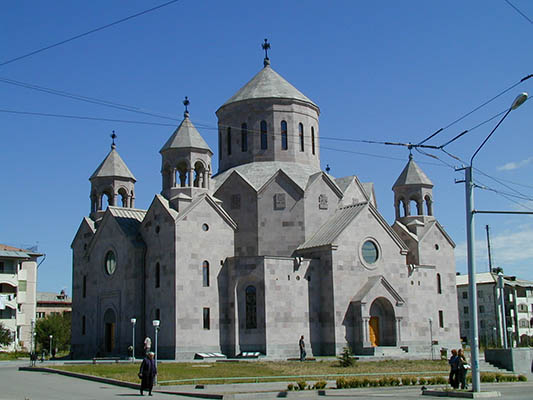
Gyumri is also known for its rich cultural life.There are several interesting museums here, telling about the history and culture of the region, a rich art gallery and two theaters. There are practically no ancient temples left here – the Persian rule has an effect, so most of the churches were built in the 19th century. There are five of them, and there is also a monastery. The most beautiful temple in Gyumri is considered to be the Church of the Savior (Amenaprkich). It was built in the second half of the 19th century and in many ways repeats the image of the Ani Cathedral, which can be seen in Turkey. True, the Gyumri version was made more spacious, and the windows acquired a round shape. The church was able to survive all the historical and political vicissitudes of the difficult twentieth century, but in 1988 it was almost completely destroyed by a powerful earthquake. Already in our century, the process of reconstruction began, which has not been completed to this day. The churches are being restored to their original appearance, the bell tower blown up in 1937 is being restored, and the interior is being re-decorated with rich ornamental paintings, which the temple was so proud of.


In Gyumri, you can also find a unique monument to Vardan Mamikonyan. This famous Armenian hero lived in the fifth century AD. A true defender of the Christian faith, he led his army, only half of which consisted of warriors, the rest were women, children, and peasant militiamen, against an army of Persians that was more than twice as numerous. One hundred thousand against two hundred and thirty thousand. The tragic outcome was predetermined – the Armenian army was defeated, its remnants hid in the mountains of the region, and the military leader Vardan Mamikonyan himself died. But the Persian Shah, frightened by the scale of the uprising, returned many freedoms to the Armenian people, including religion, ending the Christian persecution in Armenia. For his feat, Vardan and the soldiers who died with him were canonized, and monuments to the hero can be found in many cities of Armenia.


A famous monument that appeared here in the nineteenth century is the Black Fortress, which was originally called Alexandropol. The building was perfectly preserved, probably due to the monumentality of the entire structure, and was able to survive all the tragedies and disasters that befell the city. In this complex, you can see the barracks, semicircular in shape, and the surviving residential buildings (settlements). The fortress was most likely built on the site of an older structure, possibly serving the same function. Thus, archaeologists who worked on the territory of the citadel managed to find objects here that belonged to more ancient cultural layers. It was decided to build a fort to protect these lands from attacks by the Persians or Turks. But soon, from an exclusively defensive structure, the citadel turned into a real city center.


If you come to Gyumri for a few days, you will not have any problems with accommodation – there are several wonderful hotels in Armenia here.