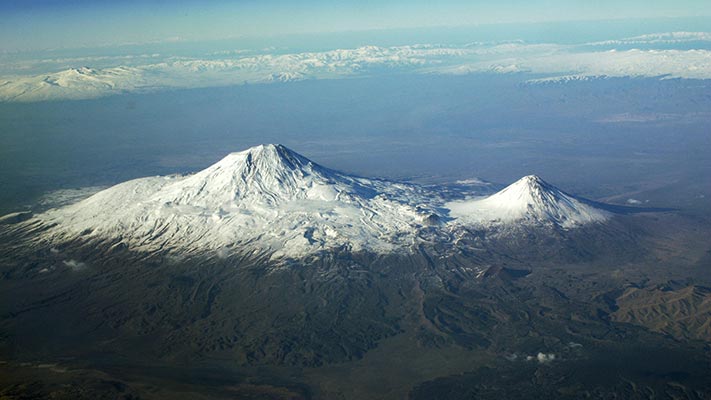
Ararat

Did you know that it was at the top of Ararat that Noah’s mighty ark once moored, releasing from its echoing walls a bleating, growling and chirping herd, the chosen remnants of the human race? Although Kostik’s words from the famous “Pokrovsky Gates” are not to be trusted, and the remains of the wooden shipbuilding colossus have never been found, the top of this beautiful mountain is by no means the worst pier. First of all, because of the fertile valleys to which the majestic mountain slopes flow. Armenians have always considered this monumental cone to be their true homeland and firmly believe that it was the people who descended the gangway and stepped onto the damp soil of Ararat when the muddy streams finally subsided that were Armenians.


Majestic Ararat is by no means modest in its size, which is probably why Armenians have called the mountain the Giant since ancient times. To go around the slopes of this stone cone, you will need to cover forty kilometers. The fluffy snow cap that crowns the proud forehead of Ararat is eternal glaciers. Playful streams and stormy rivers that originate in this icy shell draw bizarre patterns on the green velvet of the slopes and generously feed a section of the Anatolian plain. The now tame Ararat was once an active volcano, and the last time its depths shook, shaking the surrounding lands, was in the mid-19th century. The hint was understood, and since then not a single Armenian settlement has appeared in its foothills. Perhaps it was the mountain’s harsh character and tendency to outbursts of rage that gave rise to many legends about evil demons imprisoned in the depths of Ararat, who day and night break free from their chains and dream of bringing an end to this world.


The sparkling peak here, covered with a strong helmet of eternal ice, bears the name Agri-Dagi, which in translation sounds roughly as “mountain of suffering.” However, this is by no means the only name given to the mountain by Armenians. They also called it Masis, and believed that it was inhabited by vishaps – malicious spirits of water and the great king of snakes, to whom all the surrounding snakes came to bow once every seven years.


Mount Ararat does not currently belong to Armenia, and since 1921 it has been under the control of Turkey. This does not prevent Armenians from using it as a symbol and depicting it on the national coat of arms. According to historical legend, when this fact outraged the Turkish authorities, since Ararat was no longer part of Armenia at that time, the response was immediate. The crescent moon shining on the coat of arms of Turkey, or the same Moon, is definitely not part of Turkey.


According to the modern map, Ararat is located in the border zone, only thirty kilometers from the border with Armenia and 16 kilometers from the border with Iran. You can also get to Ararat from the Turkish side, but the best views open up from the Armenian land. However, if you decide to choose the latter route, you may encounter some difficulties at the border, so if a walk along the picturesque slopes is on your program, then the journey should start from Turkey. Take a flight with Uzbekistan Airways to Istanbul, and then rent a car, or buy a ticket for a scheduled bus to the town of Dugubayazit, from which the slopes of the majestic Ararat are literally a stone’s throw away. Or you can try to get a last-minute tour to Turkey – this option will be cheaper in some cases. You can, of course, explore the slopes and try to find ancient monuments on your own, but it is better to turn to a professional guide. He will be able to show you a lot of amazing and unique places that you are unlikely to find on your own.


For those who dream of conquering the summit of ancient Ararat – suddenly they will be able to find a fragment of the ark – a mountaineering club has been opened in Dugubayazit, which you must join before starting the ascent. It is not one of the most difficult, and the only thing you need to do is go through the appropriate formalities. However, do not forget that in ancient times, Armenians considered conquering the summit of the proud sister Masis a terrible crime.


The best time to visit Ararat, unless you are a fan of bone-crushing frosts, is late spring and early autumn. In summer it can be hot here – up to +25 degrees, and the landscapes themselves, whitened and dried by the sun’s heat, do not look so enchanting. In winter, the temperature often drops below -5 degrees, piercing harsh winds, chilly nights, all this is compensated by the shining snow cape that wraps Ararat, giving it a different, otherworldly beauty. The most amazing thing is that the weather conditions in places located literally a couple of kilometers from each other on the mountain slope, but at different altitudes, can be completely different. The sun can shine below, and the shoulders of the mountain will be wrapped in a chilly fog, or vice versa. Meadows painted with bright colors, sharp fangs of rocks, transparent ribbons of streams and a pearl scattering of riffles, extinct craters of volcanoesin – all these are the picturesque slopes of Ararat. These beauties arouse unflagging interest among travelers. Even Uzbekistan, famous for its amazing natural beauty, cannot offer such a combination of picturesque landscapes and rich cultural heritage.